
Alzheimer’s disease

Understanding Alzheimer’s disease

Alzheimer’s disease is a progressive brain disorder that affects memory, thinking skills, and behavior. Symptoms gradually grow serious enough to interfere with daily life. It is the most common cause of dementia, accounting for 60-80% of cases. It is estimated that over 7 million Americans are living with Alzheimer’s disease.

Alzheimer’s disease occurs when amyloid beta protein fragments (called plaques) and tau fibers (called tangles) accumulate in the brain. These plaques and tangles infer with brain cell signals and damage brain cells. This means that healthy brain cells stop working, cannot communicate with other brain cells, and die. These changes in the brain usually begin in areas responsible for memory and, later, spread to affect broader cognitive and behavioral functions as the disease progresses.
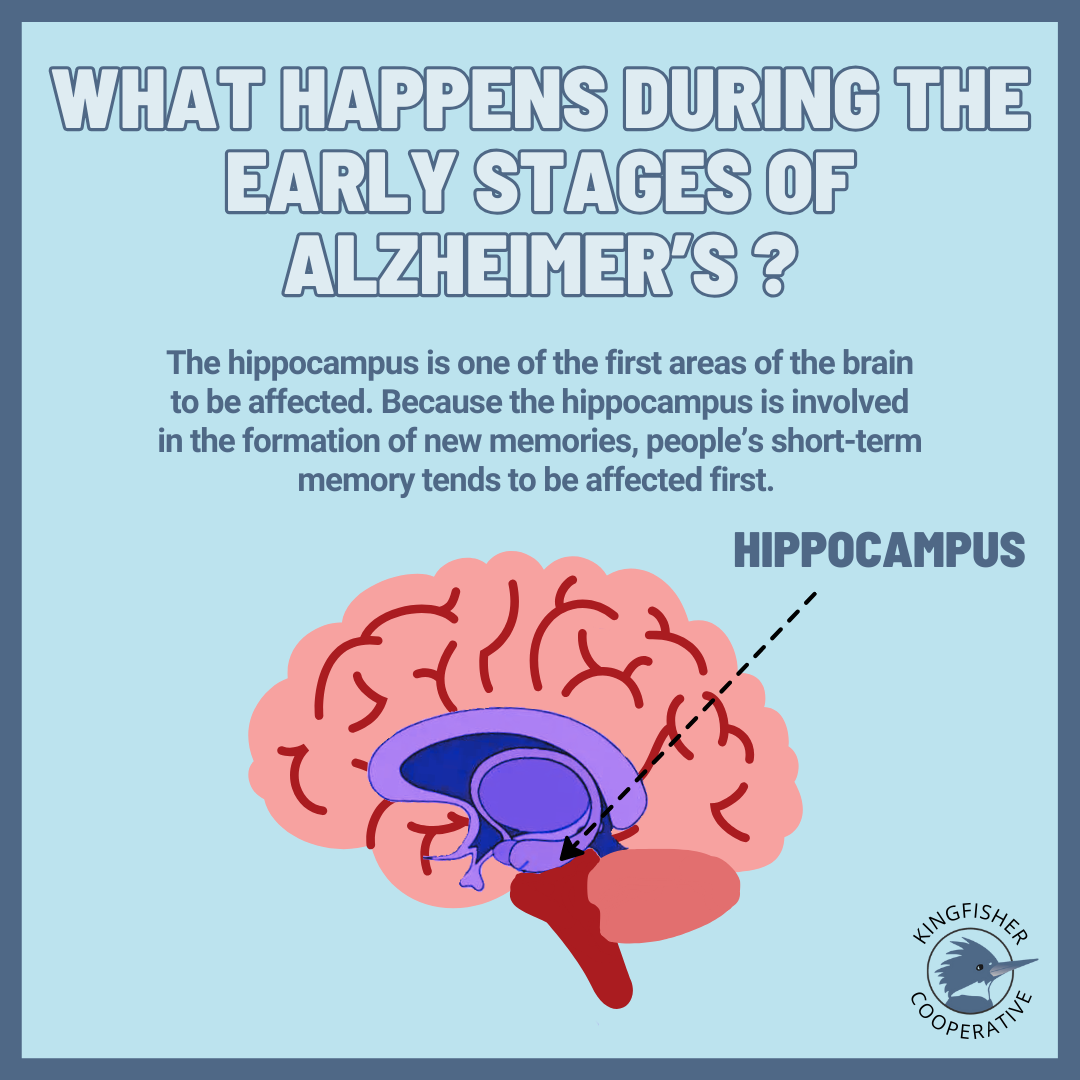
Cartoon brain with arrow pointing at the hippocampus. Text says, "What happens during the early stages of Alzheimer's? The hippocampus is one of the first areas of the brain to be affected. Because the hippocampus is involved in the formation of new memories, people's short term memory tends to be affected first.

The disease primarily affects people over 65, though early-onset Alzheimer’s can occur in younger individuals. While age is the biggest known risk factor, Alzheimer’s is not a normal part of agingand it’s precise causes are not fully understood. There is currently no cure, but treatments and support services are available to manage symptoms and improve quality of life.

Symptoms

Alzheimer’s typically begins with mild memory problems and difficulties in recalling recent events or conversations. Over time, symptoms worsen to include confusion, impaired reasoning, language problems, disorientation, mood and behavior changes, and ultimately, the inability to perform basic daily tasks independently.

Prevention

  • Make an appointment with your health care provider.
  • Control blood pressure, blood cholesterol and blood sugars
  • Limit medications and supplements to those that are necessary.
  • Participate in aerobic exercise for 90 minutes per week.
  • Aerobic exercise can reduce the risk of Alzheimer’s by 60%.
  • Limit alcohol consumption.
  • Do not use tobacco products.
  • Read, engage, volunteer (book club, food bank, movie club)
  • Try a new activity, experiment with new music, taste new foods.
  • Complex and interactive games (Scrabble®, Cribbage) are best.
  • Repetitive and solitary games (Sudoku, Solitaire) are of questionable value.
  • Consider counseling or therapy for yourself or as a group.
  • Limit fat, red meat, and alcohol. Aim for a healthy weight.
  • Drink water. Drink more if you’re dizzy or have dark urine.
  • Increase fruits and vegetables in your diet.
  •  Consider vitamins and supplements for memory support.
    • Vitamin B12
    • Vitamins C, E, K2/D3 (questionable benefit)
    • Magnesium threonate, folic acid, zinc, fish oil (questionable benefit)
  • Decide on an endpoint on when to stop driving a car, not if.
  • Plan to discuss retirement from driving before it becomes an issue.
  • Express concern while providing love and support.
  • Provide a consistent message regarding safety.
  • Consider physician involvement in decision making.
  • Get tested if:
    • Unable to locate familiar places
    • Driving too fast or too slowly
    • Not observing traffic signs or lights
    • Hitting curbs or not staying in lane
  • Falls are the number one cause of injury in people over the age of 65.
  • Head injury is a risk factor for dementia and can worsen existing dementia.
  • Talk with your healthcare provider about medication side effects
  • Assess environment for fall risks
  • Encourage close-toed, close-heeled shoes
  • Remove or secure area rugs
  • Ensure handrails and anti-slip steps
  • Consider shower chair
  • Remove clutter
  • Enhance lighting
  • Discuss current medications with a physician.
  • With assistance, stop medications and supplements that aren’t needed.
  • Become familiar with what each medication does.
  • Become familiar with what each medication looks like.
  • Set a routine for taking medications.
  • Use a pill box if taking ≥ 1 medication.
  • Have assistance with filling the pill box.
  • Monitor how the pill box is being used.
  • Set message reminders and alerts.
  • Assist with medication management.
  • Case management and/or Cognitive Care Planning
  • Long-term planning (Five Wishes: https://www.fivewishes.org/ )
  • Financial and estate planning
  • Establish Power of Attorney

Dementia Legal Planning Toolkit

Prevention

While there’s no guaranteed way to prevent Alzheimer’s disease, research suggests that certain lifestyle choices can significantly lower the risk of developing it or delay its onset. These include staying physically and mentally active, maintaining a healthy diet, and managing other health conditions.

  • Make an appointment with your health care provider.
  • Control blood pressure, blood cholesterol and blood sugars
  • Limit medications and supplements to those that are necessary.
  • Participate in aerobic exercise for 90 minutes per week.
  • Aerobic exercise can reduce the risk of Alzheimer’s by 60%.
  • Limit alcohol consumption.
  • Do not use tobacco products.
  • Read, engage, volunteer (book club, food bank, movie club)
  • Try a new activity, experiment with new music, taste new foods.
  • Complex and interactive games (Scrabble®, Cribbage) are best.
  • Repetitive and solitary games (Sudoku, Solitaire) are of questionable value.
  • Consider counseling or therapy for yourself or as a group.
  • Limit fat, red meat, and alcohol. Aim for a healthy weight.
  • Drink water. Drink more if you’re dizzy or have dark urine.
  • Increase fruits and vegetables in your diet.
  •  Consider vitamins and supplements for memory support.
    • Vitamin B12
    • Vitamins C, E, K2/D3 (questionable benefit)
    • Magnesium threonate, folic acid, zinc, fish oil (questionable benefit)
  • Decide on an endpoint on when to stop driving a car, not if.
  • Plan to discuss retirement from driving before it becomes an issue.
  • Express concern while providing love and support.
  • Provide a consistent message regarding safety.
  • Consider physician involvement in decision making.
  • Get tested if:
    • Unable to locate familiar places
    • Driving too fast or too slowly
    • Not observing traffic signs or lights
    • Hitting curbs or not staying in lane
  • Falls are the number one cause of injury in people over the age of 65.
  • Head injury is a risk factor for dementia and can worsen existing dementia.
  • Talk with your healthcare provider about medication side effects
  • Assess environment for fall risks
  • Encourage close-toed, close-heeled shoes
  • Remove or secure area rugs
  • Ensure handrails and anti-slip steps
  • Consider shower chair
  • Remove clutter
  • Enhance lighting
  • Discuss current medications with a physician.
  • With assistance, stop medications and supplements that aren’t needed.
  • Become familiar with what each medication does.
  • Become familiar with what each medication looks like.
  • Set a routine for taking medications.
  • Use a pill box if taking ≥ 1 medication.
  • Have assistance with filling the pill box.
  • Monitor how the pill box is being used.
  • Set message reminders and alerts.
  • Assist with medication management.
  • Case management and/or Cognitive Care Planning
  • Long-term planning (Five Wishes: https://www.fivewishes.org/ )
  • Financial and estate planning
  • Establish Power of Attorney

Dementia Legal Planning Toolkit